Difference between revisions of "Os04g0541700"
(→Labs working on this gene) |
|||
| Line 18: | Line 18: | ||
===Evolution=== | ===Evolution=== | ||
| − | Oshox22 belongs to the homeodomain-leucine zipper (HD-Zip) family I of transcription factors. The HD-Zip genes, are an abundant group of transcription factors that are exclusively found in plants<ref name="ref 1"/>. The NJ tree (Fig. 5) shows that the HD-Zip genes of family I can be divided into nine clades as ''α'', ''β''1, ''β''2, ''γ'', ''δ'', ''ε'', ''ζ'', ''φ''1 and ''φ''2<ref name="ref 2"/>. Subfamilies IB, IC and ID all have an intron at the same position in the Zip region. ''Oshox22'' belongs to subfamily IB. | + | Oshox22 belongs to the homeodomain-leucine zipper (HD-Zip) family I of transcription factors. The HD-Zip genes, are an abundant group of transcription factors that are exclusively found in plants<ref name="ref 1"/>. The NJ tree (Fig. 5) shows that the HD-Zip genes of family I can be divided into nine clades as ''α'', ''β''1, ''β''2, ''γ'', ''δ'', ''ε'', ''ζ'', ''φ''1 and ''φ''2<ref name="ref 2"/>. Subfamilies IB, IC and ID all have an intron at the same position in the Zip region. ''Oshox22'' belongs to subfamily IB. |
==Labs working on this gene== | ==Labs working on this gene== | ||
| Line 44: | Line 44: | ||
</ref> | </ref> | ||
</references> | </references> | ||
| + | |||
| + | ==Structured Information == | ||
Revision as of 08:17, 9 March 2017
Gene Os04g0541700,namely Oshox22,means Homeobox-leucine zipper protein HOX22.
Contents
Function


Fig. 2 Interactions of Oshox22 with the HD-Zip binding site AH2 (CAAT(C/G)ATTG) and activation of reporter gene expression in a transient expression system using rice protoplasts [1] .
- Oshox22 (Os04g0541700) is located on chromosome 4 and encodes a protein of 262 amino acids (AA) including a 61-AA HD domain for DNA binding and a 43-AA Zip domain for protein–protein interactions[1](Fig. 1).
- Oshox22 is a nuclear-localized protein. Trans-activation assays in yeast and transient expression analyses in rice protoplasts demonstrated that Oshox22 is able to bind the CAAT(G/C)ATTG element and acts as a transcriptional activator that requires both the HD and Zip domains[1]. This is typical of HD-Zip I family transcription factors[2].
- Transient expression assays were carried out with effector and reporter plasmids in rice protoplasts to confirm the interaction between Oshox22 protein and pseudopalindromic AH1 (CAAT(A/T)ATTG) and AH2 (CAAT(C/G)ATTG) sequences. Two reporter plasmids, 4AH1-90-GUS and 4AH2-90-GUS[2] [3] were used, in which the AH1 and AH2 tetramers were fused to a CaMV -90 35S minimal promoter. Construct Pro35SOshox22 with Oshox22 expressed under control of the CaMV 35S promoter was used as an effector. The data show in Fig. 2 indicate that Oshox22 is capable to activate transcription of the reporter gene when upstream HD-Zip binding sites AH1 or AH2 are present. The interaction is less effective at the AH1 site than that at AH2[1].
- Oshox22 functions in regulating ABA biosynthesis and ABA-mediated drought and salt tolerances in rice. The differences in ABA levels are likely causing changes in sensitivity of germinating and developing seedlings towards exogenous applied ABA[1].
- The expression of Oshox22 is responsive to drought, salinity and ABA treatments, suggesting its role in regulating stress tolerance[1].
Expression
- Expressed in seedlings, roots, stems, leaf sheaths and blades and panicles.
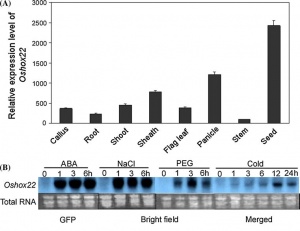 Fig. 3 Expression profiling of Oshox22[1] .
 - Oshox22 is demonstrated as a nuclear-localized protein[1].
- Zhang S et al.[1] used quantitative RT-PCR(qRT-PCR) to analyse RNA samples from different rice tissues at several developmental stages. The results showed that Oshox22 is ubiquitously expressed, with a lower level in stems and higher in panicles and seeds(Fig. 3a).
- Agalou et al.[4] demonstrated that the expression of Oshox22 in rice is strongly induced by drought, and that the induction is higher in three drought tolerant upland cultivars compared with three lowland cultivars. Zhang S et al.[1] monitored the Oshox22 expression under different abiotic stress conditions. As shown in Fig. 3b, Oshox22 was rapidly and strongly induced by NaCl, PEG and ABA, and weakly induced by low temperature[1] .

Evolution
Oshox22 belongs to the homeodomain-leucine zipper (HD-Zip) family I of transcription factors. The HD-Zip genes, are an abundant group of transcription factors that are exclusively found in plants[1]. The NJ tree (Fig. 5) shows that the HD-Zip genes of family I can be divided into nine clades as α, β1, β2, γ, δ, ε, ζ, φ1 and φ2[2]. Subfamilies IB, IC and ID all have an intron at the same position in the Zip region. Oshox22 belongs to subfamily IB.
Labs working on this gene
- S. Zhang, L. Jiang, C.-M. Liu, P. B. F. Ouwerkerk: Key Laboratory of Plant Molecular Physiology, Institute of Botany, Chinese Academy of Sciences, Beijing 100093, China. e-mail: p.b.f.ouwerkerk.2@gmail.com
- S. Zhang, L. Jiang: Graduate School of Chinese Academy of Sciences, Beijing 100049, China
- S. Zhang, A. H. Meijer, P. B. F. Ouwerkerk: Institute of Biology, Leiden University, P.O. BOX 9505, 2300 RA Leiden, The Netherlands
- I. Haider, W. Kohlen, H. Bouwmeester. Laboratory of Plant Physiology, Wageningen University, Droevendaalsesteeg 1, 6708 PB Wageningen, The Netherlands
- H. Schluepmann. Department of Molecular Plant Physiology, Utrecht University, Padualaan 8, 3584 CH Utrecht, The Netherlands
- A. Agalou, S. Purwantomo, A. Estiati, R. J. de Kam, M. Wang, A. H. Meijer, P. B. F. OuwerkerkInsti: tute of Biology, Clusius Laboratory, Leiden University, P.O. Box 9505, 2300 RA Leiden, The Netherlands. e-mail: p.b.f.ouwerkerk@biology.leidenuniv.nl
References
- ↑ 1.00 1.01 1.02 1.03 1.04 1.05 1.06 1.07 1.08 1.09 1.10 1.11 Zhang S, Haider I, Kohlen W, Jiang L, Bouwmeester H, et al. Function of the HD-Zip I gene Oshox22 in ABA-mediated drought and salt tolerances in rice. Plant Mol Biol. 2012 Dec;80(6):571-85.
- ↑ 2.0 2.1 2.2 Meijer AH, de Kam RJ, d'Ehrfurth I, Shen W, Hoge JHC. HD-Zip proteins of families I and II from rice: interactions and functional properties. Mol Gen Genet. 2000 Feb;263(1):12-21.
- ↑ Meijer AH, Ouwerkerk PBF, Hoge JHC. Vectors for transcription factor isolation and target gene identification by means of genetic selection in yeast. Yeast. 1998;14:1407–1416
- ↑ Agalou A, Purwantomo S, Overnäs E, Johannesson H, et al. A genome-wide survey of HD-Zip genes in rice and analysis of drought-responsive family members. Plant Mol Biol. 2008 Jan;66(1-2):87-103.

