Difference between revisions of "Os04g0541700"
(→Function) |
(→Function) |
||
| Line 7: | Line 7: | ||
* ''Oshox22'' (Os04g0541700) is located on chromosome 4 and encodes a protein of 262 amino acids (AA) including a 61-AA HD domain for DNA binding and a 43-AA Zip domain for protein–protein interactions<ref name="ref 1"/>.<br><br> | * ''Oshox22'' (Os04g0541700) is located on chromosome 4 and encodes a protein of 262 amino acids (AA) including a 61-AA HD domain for DNA binding and a 43-AA Zip domain for protein–protein interactions<ref name="ref 1"/>.<br><br> | ||
* Oshox22 is a nuclear-localized protein. Trans-activation assays in yeast and transient expression analyses in rice protoplasts demonstrated that Oshox22 is able to bind the CAAT(G/C)ATTG element and acts as a transcriptional activator that requires both the HD and Zip domains<ref name="ref 1"/>. This is typical of HD-Zip I family transcription factors<ref name="ref 2"/>.<br><br> | * Oshox22 is a nuclear-localized protein. Trans-activation assays in yeast and transient expression analyses in rice protoplasts demonstrated that Oshox22 is able to bind the CAAT(G/C)ATTG element and acts as a transcriptional activator that requires both the HD and Zip domains<ref name="ref 1"/>. This is typical of HD-Zip I family transcription factors<ref name="ref 2"/>.<br><br> | ||
| − | * Transient expression assays were carried out with effector and reporter plasmids in rice protoplasts to confirm the interaction between Oshox22 protein and pseudopalindromic AH1 (CAAT(A/T)ATTG) and AH2 (CAAT(C/G)ATTG) sequences. Two reporter plasmids, ''4AH1-90-GUS'' and ''4AH2-90-GUS''<ref name="ref | + | * Transient expression assays were carried out with effector and reporter plasmids in rice protoplasts to confirm the interaction between Oshox22 protein and pseudopalindromic AH1 (CAAT(A/T)ATTG) and AH2 (CAAT(C/G)ATTG) sequences. Two reporter plasmids, ''4AH1-90-GUS'' and ''4AH2-90-GUS''<ref name="ref 2"/> <ref name="ref 3"/> were used, in which the AH1 and AH2 tetramers were fused to a CaMV -90 35S minimal promoter. Construct ''Pro35SOshox22'' with ''Oshox22'' expressed under control of the CaMV 35S promoter was used as an effector. The data show in Fig. 2 indicate that Oshox22 is capable to activate transcription of the reporter gene when upstream HD-Zip binding sites AH1 or AH2 are present (Fig. 2c). The interaction is less effective at the AH1 site than that at AH2<ref name="ref 1"/>.<br><br> |
* Agalou et al.<ref name="ref 2"/> demonstrated that the expression of ''Oshox22'' in rice is strongly induced by drought, and that the induction is higher in three drought tolerant upland cultivars compared with three lowland cultivars.<br><br> | * Agalou et al.<ref name="ref 2"/> demonstrated that the expression of ''Oshox22'' in rice is strongly induced by drought, and that the induction is higher in three drought tolerant upland cultivars compared with three lowland cultivars.<br><br> | ||
[[File:Oshox22 binding.jpg|thumbnail|'''Fig. 2''' Interactions of Oshox22 with the HD-Zip binding site AH2 (CAAT(C/G)ATTG) and activation of reporter gene expression in a transient expression system using rice protoplasts <ref name="ref 1"/> .]] | [[File:Oshox22 binding.jpg|thumbnail|'''Fig. 2''' Interactions of Oshox22 with the HD-Zip binding site AH2 (CAAT(C/G)ATTG) and activation of reporter gene expression in a transient expression system using rice protoplasts <ref name="ref 1"/> .]] | ||
Revision as of 14:25, 7 June 2014
Gene Os04g0541700,namely Oshox22,means Homeobox-leucine zipper protein HOX22.
Contents
Annotated Information
Function
- Oshox22 (Os04g0541700) is located on chromosome 4 and encodes a protein of 262 amino acids (AA) including a 61-AA HD domain for DNA binding and a 43-AA Zip domain for protein–protein interactions[1].
- Oshox22 is a nuclear-localized protein. Trans-activation assays in yeast and transient expression analyses in rice protoplasts demonstrated that Oshox22 is able to bind the CAAT(G/C)ATTG element and acts as a transcriptional activator that requires both the HD and Zip domains[1]. This is typical of HD-Zip I family transcription factors[2].
- Transient expression assays were carried out with effector and reporter plasmids in rice protoplasts to confirm the interaction between Oshox22 protein and pseudopalindromic AH1 (CAAT(A/T)ATTG) and AH2 (CAAT(C/G)ATTG) sequences. Two reporter plasmids, 4AH1-90-GUS and 4AH2-90-GUS[2] [3] were used, in which the AH1 and AH2 tetramers were fused to a CaMV -90 35S minimal promoter. Construct Pro35SOshox22 with Oshox22 expressed under control of the CaMV 35S promoter was used as an effector. The data show in Fig. 2 indicate that Oshox22 is capable to activate transcription of the reporter gene when upstream HD-Zip binding sites AH1 or AH2 are present (Fig. 2c). The interaction is less effective at the AH1 site than that at AH2[1].
- Agalou et al.[2] demonstrated that the expression of Oshox22 in rice is strongly induced by drought, and that the induction is higher in three drought tolerant upland cultivars compared with three lowland cultivars.

Fig. 2 Interactions of Oshox22 with the HD-Zip binding site AH2 (CAAT(C/G)ATTG) and activation of reporter gene expression in a transient expression system using rice protoplasts [1] .
Expression
- Expressed in seedlings, roots, stems, leaf sheaths and blades and panicles.
- Zhang S et al.[1] use quantitative RT-PCR(qRT-PCR) to analyse RNA samples from different rice tissues at several developmental stages. The results showed that Oshox22 is ubiquitously expressed, with a lower level in stems and higher in panicles and seeds(Fig. 3a).
- They also monitored the Oshox22 expression under different abiotic stress conditions. As shown in Fig. 3b, Oshox22 was rapidly and strongly induced by NaCl, PEG and ABA, and weakly induced by low temperature[1] .
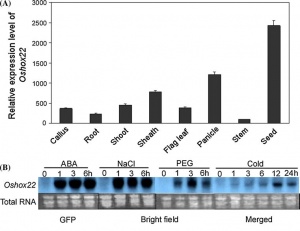 Fig. 3 Expression profiling of Oshox22[1] .

Evolution
Oshox22 belongs to the homeodomain-leucine zipper (HD-Zip) family I of transcription factors. The HD-Zip genes, are an abundant group of transcription factors that are exclusively found in plants[1]. The NJ tree (Fig. 5) shows that the HD-Zip genes of family I can be divided into nine clades as α, β1, β2, γ, δ, ε, ζ, φ1 and φ2[2]. Subfamilies IB, IC and ID all have an intron at the same position in the Zip region. Oshox22 belongs to subfamily IB.
Fig. 5 Family I is subdivided in clades α, β1, β2, γ, δ, ε, ζ, φ1 and φ2[2]. In the picture,after each gene, the intron subfamily is indicated with a box (family I), circle (family II) and triangle (family III), respectively, in different grey tones or patterns. Below: Subfamily division based on exon-intron organization. The exon-intron pattern is divided into seven subfamilies for family I (IA, IB, IC, ID, IE, IF and IG), and both family II (IIA, IIB, IIC and IID) and III (IIIA, IIIB, IIIC and IIID) have four subfamilies. Open and filled boxes represent coding and conserved domains, respectively. The HD, Zip and START domains are indicated in light grey, dark grey and black, respectively. The position of the introns is shown with black arrowheads. The white arrowhead and star (*) refers to an alternative transcript occurring with Oshox6 in subfamily IB
Labs working on this gene
Please input related labs here.
References
- ↑ 1.0 1.1 1.2 1.3 1.4 1.5 1.6 1.7 Zhang S, Haider I, Kohlen W, Jiang L, Bouwmeester H, et al. Function of the HD-Zip I gene Oshox22 in ABA-mediated drought and salt tolerances in rice. Plant Mol Biol. 2012 Dec;80(6):571-85.
- ↑ 2.0 2.1 2.2 2.3 2.4 Meijer AH, de Kam RJ, d'Ehrfurth I, Shen W, Hoge JHC. HD-Zip proteins of families I and II from rice: interactions and functional properties. Mol Gen Genet. 2000 Feb;263(1):12-21.
- ↑ Meijer AH, Ouwerkerk PBF, Hoge JHC. Vectors for transcription factor isolation and target gene identification by means of genetic selection in yeast. Yeast. 1998;14:1407–1416
Cite error: <ref> tag with name "ref_4" defined in <references> is not used in prior text.

