Difference between revisions of "File:Gggg.jpeg"
(Figure 1. Structure and expression of OsNAC6 in rice. (a) Structure of the OsNAC6 protein. The NAC domain, NAC subdomains A–E, and the putative nuclear localization signal are shown. (b) Quantitative polymerase chain reaction (PCR) analysis of OsNAC6 ex) |
(uploaded a new version of "File:Gggg.jpeg": Figure 1. Structure and expression of OsNAC6 in rice. (a) Structure of the OsNAC6 protein. The NAC domain, NAC subdomains A–E, and the putative nuclear localization signal are shown. (b) Quantita) |
(No difference)
| |
Latest revision as of 08:29, 9 June 2014
Figure 1. Structure and expression of OsNAC6 in rice. (a) Structure of the OsNAC6 protein. The NAC domain, NAC subdomains A–E, and the putative nuclear localization signal are shown. (b) Quantitative polymerase chain reaction (PCR) analysis of OsNAC6 expression under stress conditions and hormone treatments. Two-week-old rice plants grown hydroponically were dehydrated (dry), transferred to nutrient solution containing 250 mM NaCl, 100 lM ABA, 100 lM methyl jasmonate (MeJA), 100 lM salicylic acid (SA) or 100 lM ethephon, or transferred to and kept at 4�C (cold) for the indicated times. (c) Quantitative PCR analysis of OsNAC6 expression after wounding. The leaves of 2-week-old plants were wounded and kept on water-saturated filter paper for the indicated times. Relative mRNA levels for the wounded leaves (black) and undamaged leaves (white) are shown. (d) Quantitative PCR analysis of OsNAC6 in rice plants infected with blast disease. The leaves of 4-week-old plants were inoculated with rice blast fungus (Magnaporthe grisea). Relative mRNA levels for the infected leaves (black) and uninfected leaves (white) after the indicated times are shown. (e) Expression of OsNAC6 in rice cultured cells. Relative mRNA levels were analyzed using quantitative PCR. Cultured cells were grown in liquid medium containing 20 mM hydrogen peroxide (H2O2), 1 lg ml)1 N-acetylchitooligosaccharide elicitor (elicitor) or the liquid medium (medium) for the indicated times. (f) Quantitative analysis of OsNAC6 promoter–GUS transgenic rice plants under stress and hormone treatments. The 1516 bp region upstream of the start codon (ATG) was used to create rice plants containing the promoter–GUS gene. Stress and hormone treatments were performed as previously described. The plants were transferred from the basal nutrient solution to nutrient solution containing 20 mM H2O2 for hydrogen peroxide treatment. The GUS activities in the 24 h treated and untreated leaves or roots are shown. Relative GUS activities are shown compared with the GUS activity of the untreated leaves. (g) Quantitative analysis of OsNAC6 promoter–GUS transgenic rice plants infected with blast disease. The leaves of 4-week-old plants were inoculated with rice blast fungus. The GUS activities in the infected and uninfected leaves are shown. (h) Distribution of cis-acting elements in the promoter region of OsNAC6. DNA sequences similar to the stress-related cis-acting elements are indicated as follows: open circles, ABRE; closed circles, GCC box; closed inverted triangles, MYB recognition site; closed triangles, MYC recognition site; open diamonds, W-box; open inverted triangles, as1 motif; closed diamond, TATA.
File history
Click on a date/time to view the file as it appeared at that time.
| Date/Time | Thumbnail | Dimensions | User | Comment | |
|---|---|---|---|---|---|
| current | 08:29, 9 June 2014 | 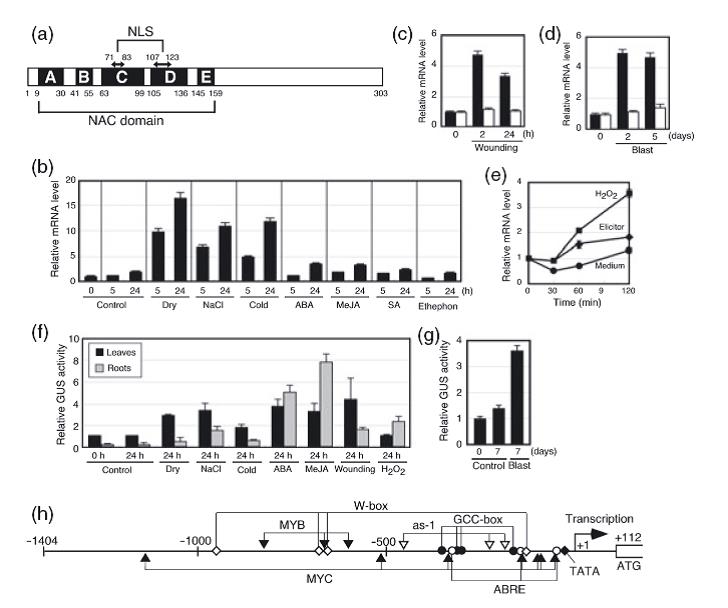 | 728 × 608 (55 KB) | Lxzlxz (talk | contribs) | Figure 1. Structure and expression of OsNAC6 in rice. (a) Structure of the OsNAC6 protein. The NAC domain, NAC subdomains A–E, and the putative nuclear localization signal are shown. (b) Quantitative polymerase chain reaction (PCR) analysis of OsNAC6 ex |
| 08:01, 9 June 2014 | 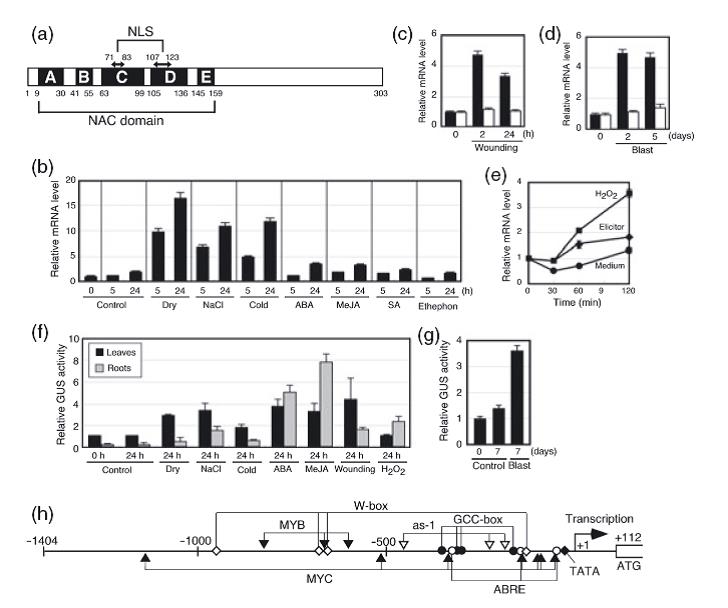 | 728 × 608 (55 KB) | Lxzlxz (talk | contribs) | Figure 1. Structure and expression of OsNAC6 in rice. (a) Structure of the OsNAC6 protein. The NAC domain, NAC subdomains A–E, and the putative nuclear localization signal are shown. (b) Quantitative polymerase chain reaction (PCR) analysis of OsNAC6 ex |
- You cannot overwrite this file.
File usage
There are no pages that link to this file.


