Difference between revisions of "OsMYB103L"
| Line 23: | Line 23: | ||
After determining the expression level of OsMYB103L in various rice organs using quantitative real-time PCR (qRT-PCR), it was found out that The expression level of OsMYB103L was highest in culm, lower in root, leaf and mature panicle, and lowest in | After determining the expression level of OsMYB103L in various rice organs using quantitative real-time PCR (qRT-PCR), it was found out that The expression level of OsMYB103L was highest in culm, lower in root, leaf and mature panicle, and lowest in | ||
| − | young panicle.(see the figure | + | young panicle.(see this fugure)[[File:20140611134107.png]] |
| − | [[File: | + | |
| + | Also the examination of the expression pattern of OsMYB103L by the β-glucuronidase(GUS) reporter gene driven by OsMYB103L putative promoter in three independent transgenic lines showed that the GUS signals were stronger in culm and weaker in vascular bundles of coleoptile, root and leaf. Meanwhile, GUS staining was stronger in mature panicle than young panicle. Further examination showed that GUS activity was detectable in pedicel, lemma and palea while no GUS activity was detected in sterile lemma, lodicule, pistil, and stamen in mature panicle. These results indicate OsMYB103L's diverse expressions in various tissues and organs in rice. | ||
| + | |||
| + | The most significant phenotype of OsMYB103L overexpression(OE) lines was upward curling of the leaf blades. This phenotype appeared first at the seedling stage and then maintained through the rest of the plant growth (Figure B, see this fugure)[[File:20140611140441.png]]. | ||
| + | The leaf blade cross-sections did not show significant differences between wild type (WT) and OE in terms of organization of the sclerenchyma and vascular tissues. It suggests that there is no obvious alteration of leaf polarity in transgenic plants. However, in contrast to WT, the leaves of transgenic plants displayed smaller bulliform cells in the rolled regions (Figure D, see this figure)[[File:20140611140519.png]]. | ||
Revision as of 06:18, 11 June 2014
OsMYB103L encodes an R2R3-MYB transcription factor, it influences leaf rolling and mechanical strength in rice (Oryza sativa L.).
Annotated information
Function
OsMYB103L, which id also called Os08g05520, encodes an R2R3-MYB transcription factor. OsMYB103L may target CESA genes for regulation of cellulose synthesis thus influences leaf shape and mechanical strength in rice, which makes it a potential engineering target for desirable leaf mechanical properties. OsMYB103L is localized in the nucleus and has transactivation activity. Overexpression of OsMYB103L in rice could result in a rolled leaf phenotype, and significantly higher levels of several cellulose synthase genes (CESAs), and a significant cellulose content increase. Knockdown of OsMYB103L by RNA interference could lead to a decreased level of cellulose content thus reduced mechanical strength in leaves. Meanwhile, the expression levels of the relevant CESA genes could also be decreased.
Structural and Homology Features
According to the rice genome annotation database ([1]), LOC_Os08g05520 encodes a putative R2R3- MYB family transcription factor with a length of 359 amino acids and a molecular mass of approximately 40 kD. The Pfam database ([2]) shows that the deduced protein has two MYB DNA-binding domains (PF00249) at the N-terminus. As revealed by phylogenetic analysis of the related MYB transcription factors in Arabidopsis thaliana and rice, Os08g05520 is closely related to At1g63910 (AtMYB103). Protein sequence alignment showed that they are highly conserved in the predicted R2- and R3-MYB DNA-binding domains. That's why Os08g05520 was designated as OsMYB103L (Oryza sativa MYB103 Like).
Expression
To determine the subcellular localization of its expression, researchers fused green fluorescent protein (GFP) to the C-terminus of OsMYB103L to produce an OsMYB103L-GFP fusion protein and monitored the fluorescence of the transiently expressed fusion protein in both rice protoplasts and onion (Allium cepa L.) epidermis cells. The results indicated that OsMYB103L is a nuclearlocalized protein, just like most transcription factors.
After determining the expression level of OsMYB103L in various rice organs using quantitative real-time PCR (qRT-PCR), it was found out that The expression level of OsMYB103L was highest in culm, lower in root, leaf and mature panicle, and lowest in
young panicle.(see this fugure)
Also the examination of the expression pattern of OsMYB103L by the β-glucuronidase(GUS) reporter gene driven by OsMYB103L putative promoter in three independent transgenic lines showed that the GUS signals were stronger in culm and weaker in vascular bundles of coleoptile, root and leaf. Meanwhile, GUS staining was stronger in mature panicle than young panicle. Further examination showed that GUS activity was detectable in pedicel, lemma and palea while no GUS activity was detected in sterile lemma, lodicule, pistil, and stamen in mature panicle. These results indicate OsMYB103L's diverse expressions in various tissues and organs in rice.
The most significant phenotype of OsMYB103L overexpression(OE) lines was upward curling of the leaf blades. This phenotype appeared first at the seedling stage and then maintained through the rest of the plant growth (Figure B, see this fugure) .
.
The leaf blade cross-sections did not show significant differences between wild type (WT) and OE in terms of organization of the sclerenchyma and vascular tissues. It suggests that there is no obvious alteration of leaf polarity in transgenic plants. However, in contrast to WT, the leaves of transgenic plants displayed smaller bulliform cells in the rolled regions (Figure D, see this figure)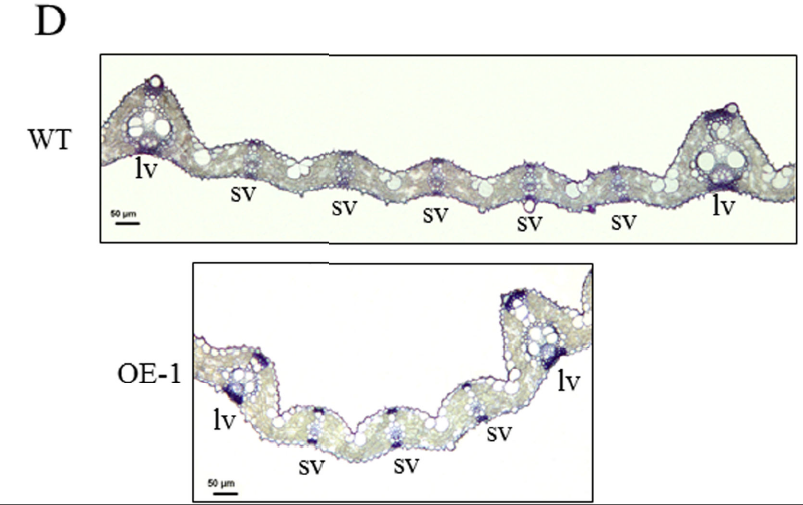 .
.


