|
|
| Line 1: |
Line 1: |
| − | Please input one-sentence summary here.
| + | The rice Os05g0573500 was reported as '''''OsHAP3B''''' in 2003 by researchers from Japan,. |
| | | | |
| | ==Annotated Information== | | ==Annotated Information== |
| | + | [[File:Os01g0834400.png|right|thumb|427px|'''Figure 2.''' ''Figure 2. Expression patterns of OsHAP3 genes.<ref name="ref1" />.'']] |
| | + | ===Gene Symbol=== |
| | + | *'''''Os01g0834400''''' '''''<=>''''' '''''OsHAP3A,HAP3A''''' |
| | + | |
| | ===Function=== | | ===Function=== |
| − | [[File:1.png|right|thumb|350px| '''Figure. 1''' ''(from reference <ref name="ref1" />)'']]
| + | * '''''OsHAP3A''''' encode a HAP3/nuclear factor-YB (NF-YB)/CCAAT binding factor-A (CBF-A) subunit of a CCAAT-box binding complex in rice (Oryza sativa) |
| − | The CCAAT-box is one of the most common promoter elements found in a large number of genes in plants. The HAP complex, which is also called NF-Y or CBF in animals, binds the CCAAT-box and regulates expression of genes.This complex consists of three distinct subunits: HAP2、HAP3、HAP5,all of which are necessary for DNA binding. Each subunit contains an evolutionary conserved domain that is responsible for DNA binding and protein-protein interaction. 10 genes for HAP2 subunit, 11 genes for HAP3 subunit and 7 genes for HAP5 subunit has been identified. HAP3A、HAP3B、HAP3C are genes encode subunits of HAP3. HAP3 genes regulate chloroplast biogenesis. In the transgenic rice plants with antisense or RNAi construct of OsHAP3A, the mRNA level of OsHAP3C was reduced and these plants showed pale green leaves, in which the amount of chlorophyll was reduced and chloroplasts were degenerated. The thylakoid membrane was hardly generated of formed only sightly along the enveolpe, no clear grana or stroma was observed and the accumulation of the starch was not evident. Instead, an electron-dense fibre-like structure was observed in the central portion of the deformed chloroplast. The chloroplast was almost empty and smaller in size.<br>
| + | * '''''OsHAP3A''''' genes regulate chloroplast biogenesis in rice. |
| − | OsHAP3C is highly similar to OsHAP3A in their amino acid sequence and it can also expressed in roots. SO it may also affect the amyloplast.<br>
| + | |
| − | a. The chloroplast of the antisense plant #31. A membrane structure of the chloroplasts was not well developed and no accumulation of starch grains was observed<br>
| + | ===Phenotypic analysis=== |
| − | b. Electron-dense fibre-like structure was observed.<br>
| + | * In the transgenic rice plants with antisense or RNAi construct of OsHAP3A, reduced expression of not only '''''OsHAP3A''''' but also '''''OsHAP3B''''' and '''''OsHAP3C''''' was observed. These plants had pale green leaves, in which the amount of chloro- phyll was reduced and chloroplasts were degenerated. |
| − | c. The amyloplast of the antisense plant #31. The reduced amount of the starch was accumulated.<br>
| + | * Lamella was not well developed and accumulation of starch was not detected. |
| − | d. The chloroplast of the antisense plant #56. Almost no membrane structure was observed inside the chloroplast. The chloroplast was small.<br>
| + | * The degenerated chloroplast formation was accompanied by reduced expression of nuclear-encoded photosynthesis genes such as RBCS and CAB, while expression of chloroplast-encoded genes was not affected or rather increased. |
| − | e. The inside of the chloroplast was almost empty.<br>
| |
| − | f. The amyloplast of the antisense plant #56. The reduced amount of the starch was accumulated.<br>
| |
| | | | |
| | ===Expression=== | | ===Expression=== |
| − | [[File:Expression.png|top|thumb|350px| '''Figure. 1''' ''(from reference <ref name="ref1" />)'']]]]
| + | * '''''OsHAP3A''''' was expressed in various organs including leaves. |
| − | RNAs isolated from indicated organs were analysed by RT-PCR. Actin was used for an internal control.Although there are some differences in their gene structure, such as OsHAP3A contains seven exons divided by six introns, and OsHAP3C contains six exons divided by five introns. OsHAP3A,OsHAP3B, OsHAP3C showed ubiquitous expression. They were expressed in all organs examined such as shoot apices, roots, young panicles, flowering panicles, young leaves, developing embryos and their surrounding tissues at 0, 2, 4, 6 and 8 Days after pollination, and regenerating calli at 0, 2, 4, 6 days after regeneration. The expression wwas also observed in developing young inflorescence with a panicle length of 1 and 3 mm, 2 and 3 cm.
| |
| − | | |
| − | ===Evolution===
| |
| − | [[File:Phylogenetic_tree_of_HAP3.png|right|thumb|350px| '''Figure 3''''' (from reference <ref name="ref1" />)'']]
| |
| − | Rice has 11 HAP3 genes in its genome, the newly identified genes were named as OsHAP3D to OsHAP3D A phylogenetic analysis based on the amino acid sequeces of the conserved domain showed that the OsHAP3 proteins were located in several different clades. A comparison of amino acid sequences in the conserved domain showed that OsHAP3 proteins are 96-39% identical to each other and also to the Arabidopsis proteins. Among the proteins in the same clade, the amino acid identities increased to not less than 77(OsHAP3A clade) and 76%(LEC1 clade). OsHAP3A,OsHAP3B and OsHAP3C also showed similarity in their C-terminus regions with 67-44% identity in 45-35 amino acid resudues. OsHAP3C protein also have the characteristic stretched of glycine amino acid residue.
| |
| | | | |
| | ==Labs working on this gene== | | ==Labs working on this gene== |
| Line 26: |
Line 23: |
| | | | |
| | ==References== | | ==References== |
| − | 1.<references><ref name="ref1"> Kazumaru Miyoshi;Yukihiro Ito;Akiko Serizawa;Nori Kurata, OsHAP3 genes regulate chloroplast biogenesis in rice, The Plant Journal, 2003, 36(4): 532-540.</ref><br>
| + | <references><ref name="ref1"> Kazumaru Miyoshi;Yukihiro Ito;Akiko Serizawa;Nori Kurata, OsHAP3 genes regulate chloroplast biogenesis in rice, The Plant Journal, 2003, 36(4): 532-540.</ref> |
| − | 2.<references><ref name="ref2"> Thiruvengadam Thirumurugan,Yukihiro Ito,Takahiko Kubo,Akiko Serizawa,Nori Kurata, Identification, characterization and interaction of HAP family genes in rice, Molecular Genetics and Genomics, 2008, 279(3): 279-289.</ref>
| + | </references> |
| | | | |
| | ==Structured Information== | | ==Structured Information== |
The rice Os05g0573500 was reported as OsHAP3B in 2003 by researchers from Japan,.
Annotated Information
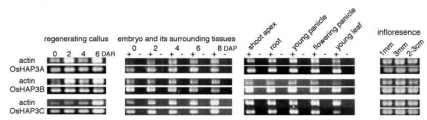
Figure 2. Figure 2. Expression patterns of OsHAP3 genes.[1]. Gene Symbol
- Os01g0834400 <=> OsHAP3A,HAP3A
Function
- OsHAP3A encode a HAP3/nuclear factor-YB (NF-YB)/CCAAT binding factor-A (CBF-A) subunit of a CCAAT-box binding complex in rice (Oryza sativa)
- OsHAP3A genes regulate chloroplast biogenesis in rice.
Phenotypic analysis
- In the transgenic rice plants with antisense or RNAi construct of OsHAP3A, reduced expression of not only OsHAP3A but also OsHAP3B and OsHAP3C was observed. These plants had pale green leaves, in which the amount of chloro- phyll was reduced and chloroplasts were degenerated.
- Lamella was not well developed and accumulation of starch was not detected.
- The degenerated chloroplast formation was accompanied by reduced expression of nuclear-encoded photosynthesis genes such as RBCS and CAB, while expression of chloroplast-encoded genes was not affected or rather increased.
Expression
- OsHAP3A was expressed in various organs including leaves.
Labs working on this gene
1.Plant Genetics Laboratory, National Institute of Genetics, 1111 Yata, Mishima, Shizuoka-ken 411-8540, Japan.
2.Department of Life Science, Graduate University for Advanced Studies, 1111 Yata, Mishima, Shizuoka-ken 411-8540, Japan.
References
- ↑ Kazumaru Miyoshi;Yukihiro Ito;Akiko Serizawa;Nori Kurata, OsHAP3 genes regulate chloroplast biogenesis in rice, The Plant Journal, 2003, 36(4): 532-540.
Structured Information


