Os11g0126900
The rice Os11g0126900 was reported as NAC (an acronym for NAM [No Apical Meristem], ATAF1-2, and CUC2 [Cup-Shaped Cotyledon]) domain gene, OsNAC10,in 2010 by Korean researchers.
Contents
Annotated Information
Function

OsNAC10 plays important role in enhancing stress tolerance when overexpressed in rice. In Jeong, J. S's et al. research, they constructed two types of transgenic plants,RCc3:OsNAC10, GOS2:OsNAC10.A phenotype evaluation of RCc3:OsNAC10, GOS2:OsNAC10 and NT control plants revealed no major differences at the vegetative growth stage of the entire plant.Under normal conditions, the grain yield of the GOS2:OsNAC10 plants remains similar to that of the NT controls. Filling rate and 1000 grain weight of the GOS2:OsNAC10 plants were markedly reduced and the reduction appeared to be balanced by the increase in numbers of panicles and total spikelets. While under the same conditions, RCc3:OsNAC10 plants’ total grain weight was increased by 5% to 14% compared with the NT controls, which was due to increased numbers of filled grains and total spikelets. Under drought conditions, RCc3:OsNAC10 plants’ total grain weight increased 25% to 42% compared with NT controls. In contrast, GOS2:OsNAC10 plants remain similar total grain weight with NT controls under drought condition. Root volume, length, dry weight, and diameter of RCc3:OsNAC10, GOS2:OsNAC10, and NT plants were measured after growth to the stage of reproduction. Root diameter of the RCc3:OsNAC10 plants was thicker than that of the GOS2:OsNAC10 and NT plants. The increase in root diameter of the RCc3:OsNAC10 plants appears to be caused by an increase in cell number rather than cell size, as evidenced by the similar size of epidermal and exodermal cells between NT and RCc3:OsNAC10 roots.(finger 1)[1]
Expression
- OsNAC10 is expressed predominantly in roots and panicles[1] (finger 2 A).
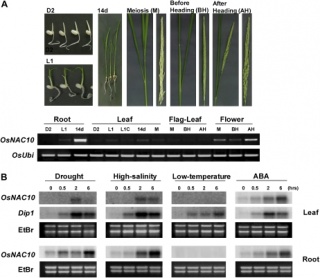 Figure 2.Expression analyses of OsNAC10(from reference [1]).

- The expression of OsNAC10 is induced by drought, high salinity, and ABA but not by low temperature[1].(finger 2 B)
- 34 root-specific and 40 leaf-specific target genes were up-regulated when OsNAC10 was overexpressed in transgenic plants.Transcript levels of seven root-specific target genes [P450, Zn-finger, HAK5, 2OG-Fe(Ⅱ),NCED, NAC, and KUP3] were increased in transgenic roots. Expression of two leaf-specific target genes, LRR and Peroxidase, was found to be OsNAC10 dependent only in GOS2:OsNAC10 leaves but not in RCc3:OsNAC10 leaves. Expression of two common target genes, F-box and Muts4, was found to be OsNAC10 dependent both in roots and leaves of the GOS2:OsNAC10 plants[1].
Evolution
- According to the phylogenic analysis of the amino acid sequences of 18 OsNAC proteins, OsNAC10 is in the subgroup Ⅰ[1].
Knowledge Extension
- Name of NAC. It derives from the three genes first described as containing the domain, no apical meristem (NAM) gene of Petunia [2] and the ATAF1, ATAF2 and CUC (cup-shaped cotyledon) genes of Arabidopsis [3].
- Structure of NAC. NAC proteins share a well conserved N-terminal NAC domain (∼150 amino acids; aa) and a diversified C-terminal transcription regulatory (TR) region.(finger 4a)[4]The DB ability of NAC TFs is confined to the NAC domain which can be divided into five subdomains.(A–E;Figure 3a (i))The highly conserved positively charged subdomains C and D bind to DNA, whereas subdomain A may be involved in the formation of a functional dimer, and the divergent subdomains B and E may be responsible for the functional diversity of NAC genes.[5][6][7][8]The TRR, generally lying at the highly diverged C-terminal [Figure 3a (i)], can either activate or repress transcription.[4]
- Regulation of NAC TFs. Expression of stress-responsive NACs may be tightly regulated by several stress-responsive cis-acting elements contained in the promoter region ( Figure 4b).[4]These include the ABREs (ABA-responsive elements), DREs, LTREs (Low-temperature responsive elements), MYB (Myeloblastosis) and MYC (Myelocytomatosis) binding sites, W-Box, jasmonic acid responsive element and salicylic acid responsive element
You can also add sub-section(s) at will.
Labs working on this gene
- School of Biotechnology and Environmental Engineering, Myongji University, Yongin 449-728, Korea.
- National Academy of Agricultural Science, Suwon 441–707, Korea.
- School of Agricultural Biotechnology, Seoul National University, Seoul 151–921, Korea.
- CropDesign NV, B–9052 Ghent, Belgium
References
- ↑ 1.0 1.1 1.2 1.3 1.4 1.5 1.6 Jeong, J. S., Kim, Y. S.,Baek, K. H.,et al. (2010). "Root-specific expression of OsNAC10 improves drought tolerance and grain yield in rice under field drought conditions." Plant Physiol 153(1): 185-197.
- ↑ Souer E, van Houwelingen A, Kloos D,et al. (1996)."The no apical meristem gene of Petunia is required for pattern formation in embryos and flowers and is expressed at meristem and primordia boundaries."Cell 85(2):159–170
- ↑ Aida M, Ishida T, Fukaki H,et al. (1997)."Genes involved in organ separation in Arabidopsis: an analysis of the cup-shaped cotyledon mutant." Plant Cell 9(6):841–857
- ↑ 4.0 4.1 4.2 Puranik, S.,Sahu, PP. Srivastava,PS.,et al. (2012). "NAC proteins: regulation and role in stress tolerance." Trends Plant Sci 17(6): 369-381.
- ↑ Ernst HA, Olsen AN, Larsen S,et al.(2004)."Structure of the conserved domain of ANAC, a member of the NAC family of transcription factors."EMBO Rep.5(3):297–303
- ↑ Jensen MK, Kjaersgaard T, Nielsen MM, et al.(2010)."The Arabidopsis thaliana NAC transcription factor family: structure-function relationships and determinants of ANAC019 stress signalling." Biochem J.426(2):183-96
- ↑ Chen Q, Wang Q, Xiong L, et al.(2011)"A structural view of the conserved domain of rice stress-responsive NAC1." Protein Cell,2(1):55–63
- ↑ Ooka H, Satoh K, Doi K,et al.(2003)."Comprehensive analysis of NAC family genes in Oryza sativa and Arabidopsis thaliana."DNA Res., 10(6):239–247

