IC4R006-Proteomic-2007-17132620
From RiceWiki
Project Title
- Proteomics Identification of Differentially Expressed Proteins Associated with Pollen Germination and Tube Growth Reveals Characteristics of Germinated Oryza sativa Pollen
The Background of This Project
- Mature pollen from most plant species is metabolically quiescent; however, after pollination, it germinates quickly and gives rise to a pollen tube to transport sperms into the embryo sac. Because methods for collecting a large amount of in vitro germinated pollen grains for transcriptomics and proteomics studies from model plants of Arabidopsis and rice are not available, molecular information about the germination developmental process is lacking. In this project, the researchers describe a method for obtaining a largequantity of in vitro germinating rice pollen for proteomics study.
Plant Culture & Treatment
- Collection and in Vitro Germination of Mature Rice Pollen Grains (MPGs)—Rice cultivar Zhonghua 10 (Oryza sativa L. ssp. japonica) was planted under a natural growth season in Beijing (39° 54' N, 116° 24’ E). The plants were managed as usual. MPGs were collected by shaking panicles gently during anthesis. These collected fresh MPGs were transferred into a liquid germination medium (20% sucrose, 10% polyethylene glycol 4000, 3 mM Ca(NO3)2·4H2O, 40 mg/liter H3BO3, 3 mg/liter vitamin B1) and cultured for about 10 min at room temperature (~30 °C) to generate synchronously germinated rice pollen grains (GPGs). The amount of GPGs was examined under a microscope (also see below). After anther debris were removed by filtering the pollen culture through cheesecloth, GPGs were collected by centrifuging at 500 x g. MPGs and GPGs were used immediately for extracting proteins or stored at -80 °C until use.
Protein Extraction and 2-D PAGE
- Preparation of Proteins from MPGs and GPGs—MPGs and GPGs were homogenized in a homogenate buffer (50 mM Tris-HCl, pH 7.5, 20 mM KCl, 2% Nonidet P-40, one tablet of protease inhibitor mixture/ 25 ml (Roche Applied Science), 13 mM DTT) with use of a chilled mortar and pestle. Supernatant was collected by centrifugation at 18,000 x g for 20 min at 4 °C and then supplemented with trichloroacetic acid to a final concentration of 12.5% to precipitate proteins on ice for 2 h. Proteins were pelleted by centrifugation at 15,000 x g for 20 min at 4 °C and then resuspended in 80% cold acetone containing 0.07% β mercaptoethanol. The mixture was placed at -20 °C for 30 min to allow proteins to precipitate, and proteins were collected by centrifugation at 15,000 x g for 20 min at 4 °C. After being rinsed with cold acetone with 0.07% β-mercaptoethanol and dried by vacuum, the resulting proteins were dissolved in a lysis buffer (7 M urea, 2 M thiourea, 4% Nonidet P-40, 13 mM DTT, 2% Pharmalyte 3–10) and used for 2-DE immediately or stored in aliquots at -80 °C after debris were removed by centrifugation at 20,000 x g for 20 min at 4 °C. For protein preparation of MPGs or GPGs, triplicate biological samples were used. Protein concentrations were determined according to the Bradford method (18) by DU640 UV-visible spectrophotometry (Beckman). Bovine serum albumin was used as the standard.
Research Findings
- Two-dimensional electrophoresis of ~2300 protein spots revealed 186 that were differentially expressed in mature and germinated pollen. The analyses detected 66 development stage-specific protein spots and 120 spots with a changed level of expression in the MPG and GPG protein profiles (186 in total) (Figs. 1 and 2).
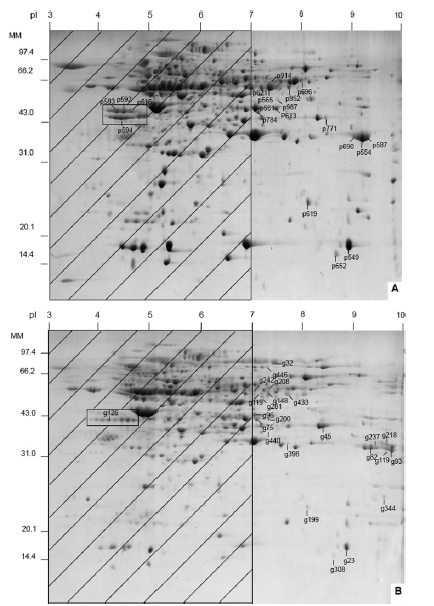
Figure 1 Representative 2-DE images of MPG (A) and GPG (B) proteins in the pH 3–10 range. 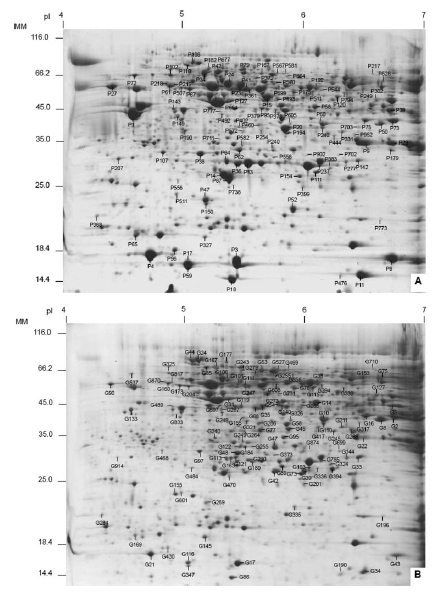
Figure 2 Representative 2-DE images of MPG (A) and GPG (B) proteins in the pH 4–7 range. - The MS analyses led to the identification of 160 protein spots, 126 identified by PMFs on MALDI-TOF MS (Fig. 3A), and 34 identified by amino acid sequences of peptides on ESI Q-TOF MS/MS (Fig. 3, B and C). The 160 identities represent 120 unique proteins (Unipros).
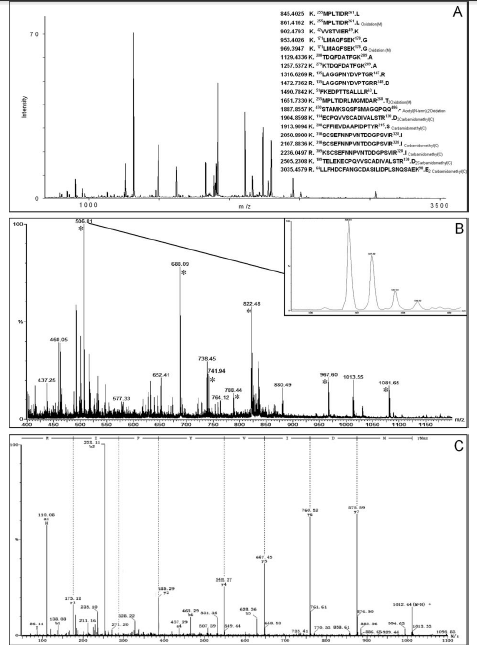
Figure 3 Representative 2-DE images of MPG (A) and GPG (B) proteins in the pH 4–7 range. - In combination with metabolic and functional features of pollen, the researchers grouped all the identities into 13 major categories (Fig. 1A). An impressive 74% of these identities were implicated in five functional groups, including carbohydrate/ energy metabolism (24%), wall remodeling and metabolism (24%), protein metabolism (11%), cytoskeleton dynamics (8%), and stress response (7%) (Fig. 1A). Analysis of their relative expression level in each category revealed an identical trend (Fig. 1B); these cellular/metabolic process-related proteins were overrepresented either in number or expression level of the identified differentially expressed proteins, suggesting the functional importance of these processes in pollen tube growth.

Figure 4 An outline of the functional classification of differentially expressed proteins. - The study also revealed multiple isoforms and differential expression patterns between isoforms of a protein.
Labs working on this Project
- Research Center for Molecular and Developmental Biology, Key Laboratory of Photosynthesis and Environmental Molecular Physiology, Institute of Botany, Chinese Academy of Sciences, Beijing 100093, China
- Graduate School of Chinese Academy of Sciences, Beijing 100049, China
- Key Laboratory of Molecular and Developmental Biology, Institute of Genetics and Developmental Biology, Chinese Academy of Sciences, Beijing 100101, China
- Beijing Genomics Institute, Chinese Academy of Sciences, Beijing 101300, China
Corresponding Author


