Os02g0557200
Please input one-sentence summary here.
Contents
Annotated Information
Function
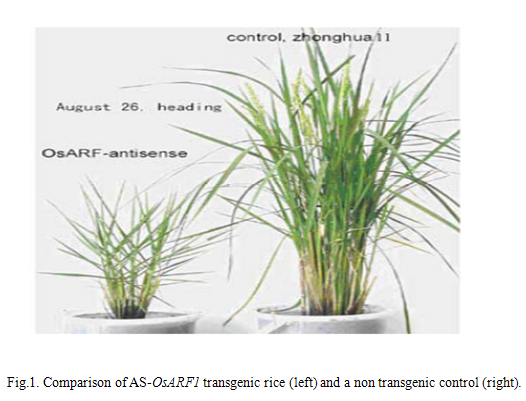
OsARF1, a rice homologue of the auxin response factor (ARF) family of transciptional regulators, is localized to the nuclues. OsARF1, classified as a primary auxin responsive gene, which is auxin-induced even in the absence of de novo protein synthesis, is regulated by auxin. OsARF1, as a transciption factor which can regulate the expresssion of genes is important for growth. In rice, elevated levels of OsARF1 transciption in tissues elevating the growth rate suggest that OsARF1 might play a positive role in the regulation of gene encoding products mediating the growth response. As the P, S, T-rich OsARF1 middle region suggests that OsARF1 acts as a repressor, the positive correlation of growth rate and high OsARF1 transcript levels might be a consequence of OsARF1 negatively regulating a repressor.[1] insertion of a cDNA fragment of OsARF1 produce an antisense (AS) construction, and AS-OsARF1 plant showed exetremely low growth.(Fig.1)[2] The ealier expression of OsARF1 promote plant growth, whereas the later expression (after 12h of colonization) may be related to infection by P. Cepacia. OsARF1 may be at the aerial parts of the plant to interact with the pathogen antagonism.[3] OsARF1 can regulate its own transciption, involving in a feedback mechanism in self-amplification of auxin signaling.[4]

Mutant reported by Yaling Song et al.[5]
T-DNA insertion mutant of OsARF1 is less sentitive to BR treatment compared with wild type. Both shoot and root elongation is more significantly inhibited in the homozygous mutant plant than that of wild type. (Fig.2.) (Fig.3.)


Expression
Semi-quantitative RT-PCR showed that the expression level of OsARF1 was extremely low. OsARF1 was transcript accumulated in cellus and young panicle at much higer amount than in leaf and root. OsARF1 may be associated with embryogenesis.[2]
Microarray analysis of regulated genes expression by OsARF1 in transgenic plants showed that in later vegetative stages, 10325genes of the total of 14688 genes were expressed at this stage. “knock down” plant cDNA microarray analysis showed that approximately 3% fo the total set of predicted genes and approximately 4% of known to be expressed genes showed significant difference among their transcirptional abundance between the transgenic plant and the controls. [2] (Fig.4.)

Evolution
Dekai Wang et al. built a phylogenetic tree from alignments of the full-length protein sequences of 25 OsARFs to examine the phylogenetic relationships among rice proteins by using MEGA3.1 program.[6] (Fig.5. )

Labs working on this gene
[1] Institut für Biologie II, Albert-Ludwigs-Universität, Schänzlestrasse 1, 79104 Freiburg;
[2] Hitachi Advanced Research Laboratory, Hatoyama, Saitama 350-0395;
[3] Nara Institute of Science and Technology, 8916-5 Takayama, Ikoma, Nara 630-0101, Japan;
[4] Rice Res & Training Ctr, Rice Biotechnol Lab, Sakha 33717, Kafr El Sheikh, Egypt
[5] Fudan Univ, Sch Life Sci, Inst Genet Engn, Shanghai 200433, Peoples R China;
[6] Key Laboratory of Monitoring and Management of Plant Pathogens and Insect Pests, Ministry of Agriculture of China;
[7] Institut of Botany, University of Karlsruhe, Kaiserstraße, 76128 Karlsruhe, Germany
[8] Crop Molecular Breeding Center, the Institute of Crop and Nuclear Technology Utilization,Zhejiang Academy of Agricultural Sciences, Hangzhou 310021, P.R. China
[9] State Key Laboratory of Rice Biology, China National Rice Research Institute, Hangzhou 310006, P.R. China
[10] National Center for Gene Research, Shanghai Institutes for Biological Sciences, Chinese Academy of Sciences, 500 Caobao Road, Shanghai 200233, P.R. China
References
[1] Frank Waller, Masaki Furuya, and Peter Nick. OsARF1, an auxin response factor from rice, is auxin-regulated and classifies as a primary auxin responsive gene[J]. Plant Molecular Biology, 2002, 50: 415–425.
[2] Kotb A. Attia, Amr F. Abdelkhlik, Megahed H. Ammar, Chun Wei, Jinshui Yang, David A, Lightfoot, Wagih M. EI-Sayed and Hany A. EI-Shemy. Antisense Phenotypes Reveal a Functional Expression of OsARF1, an Auxin Response Factor, in Transgenic Rice[J]. Plant Genomics, 2009, 11: 29–34.
[3] HAIYING RENa, GANYU GUa, JUYING LONGa, QIAN YINa, TINGQUAN WUa, TAO SONGa, SHUJIAN ZHANGa, ZHIYI CHENb and HANSONG DONGa. Combinative effects of a bacterial type-III effector and a biocontrol bacterium on rice growth and disease resistance[J]. J. Biosci, 2006, 31: 617–627.
[4] P. Nick. Noise Yields Order–Auxin, Actin, and Polar Patterning[J]. Plant Biol, 2006, 8: 360–370.
[5] Yaling Song,Jun You,Lizhong Xiong. Characterization of OsIAA1 gene, a member of rice Aux/IAA family involved in auxin and brassinosteroid hormone responses and plant morphogenesis[J]. Plant Mol Biol, 2009, 70: 297–309.
[6] Dekai Wang, Kemei Pei, Yaping Fu, Zongxiu Sun, Sujuan Li, Heqin Liu, Kan Tang, Bin Han, Yuezhi Tao. Genome-wide analysis of the auxin response factors (ARF) gene family in rice (Oryza sativa)[J]. Gene, 2007, 394: 13–24.

